

Residency in Chile
Chilean residency is the ideal document for those seeking a country with quality of life, stability, and security close to Brazil.
Residency and Birth Tourism in Chile
The Advantages of Residing in Chile
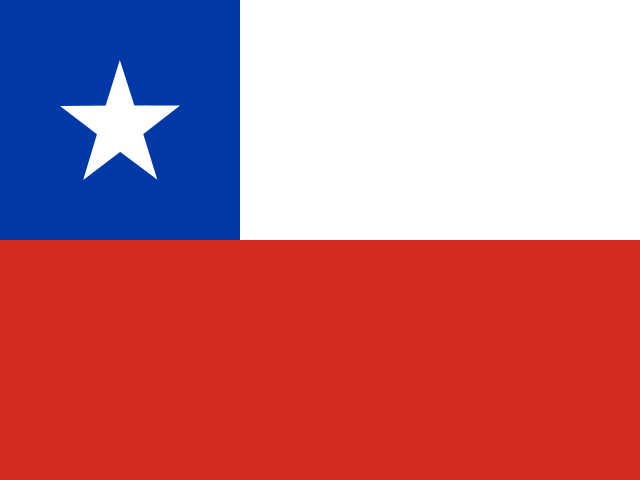
Residing in Chile is a highly advantageous option in Latin America:
- Quality of Life: Chile has a high HDI, ranking 44th globally.
- Economic Freedom: Chile ranks 21st on the Heritage Index of Economic Freedom, the highest in Latin America.
- Citizenship in 2 to 5 years: It is possible to apply for citizenship after 2 years of residency if you give birth to a child locally.
- ESTA Access: Chile is the only Latin American country with visa-free access to the U.S., Canada, and Mexico.
- APEC Card: Chilean citizens can obtain a travel card for APEC (Asia-Pacific Economic Cooperation) countries.
- Tax benefits: Income tax exemption on foreign-sourced income for 3 years.
The Temporary Residency Option
- Options:
- Mercosur: As a Mercosur citizen, you can apply for temporary residency with a birth certificate and a criminal background check.
- Rentista Visa: Proof of passive income of 1,500 USD + 500-750 USD per dependent
- Investor Visa: Invest 500,000 USD in a Chilean company with a business plan, or hire yourself as a director of a Chilean company.
- Birth tourism: Pregnant women can obtain a humanitarian permit that counts as temporary residency and is valid for one year.
- Minimum stay: The minimum stay period stipulated by law is 1 day per year. However, if you do not live in Chile, you will not be able to obtain permanent residency or citizenship.
- Citizenship: Applying for citizenship is possible after 5 years of residency, or 2 years of residency with family ties in Chile, such as a local child.
- Duration: Temporary residency is valid for two years and renewable for the same period.
- Timeline: The process until residency is issued takes about 2 months.
- Location: The temporary residency process can be completed in Chile or at an embassy or consulate abroad.
The Permanent Residency Option
- Minimum stay: To convert temporary residency into permanent, you must have effectively lived in the country for at least 2 years and spent at least 180 days in the country during the last year of temporary residency. This period can be reduced to 1 year in special cases (see FAQ).
- Truly permanent: Permanent residency is truly permanent and does not need to be renewed.
- Minimum stay: To maintain permanent residency, you cannot leave the country for more than two consecutive years. A visit every two years is sufficient to maintain residency. You can apply for a 2-year extension of this period (totaling 4 years abroad) once.
- Timeline: It takes about 3 to 6 months to be issued. Until it is issued, you will have your temporary residency.
Obtaining Citizenship and Birth Tourism in Chile
"But Chile doesn't work for birth tourism! Just look at this Wikipedia map of jus soli countries!"
Well, once again, Wikipedia only provides superficial knowledge. The truth goes deeper. It is true that if you give birth in Chile as a tourist, the child will not receive citizenship. However, Chile has a special humanitarian permit for pregnant women that takes only one month to be issued. The permit counts as temporary residency and is valid for one year.
You only need to prove sufficient income or savings to support yourself in Chile during your stay. Bank statements are sufficient for this.
If the child is born to parents who hold this permit, the baby immediately obtains Chilean citizenship. The parents can then apply for permanent residency in Chile based on that.
Chile has top-tier clinics, such as Clinica Alemana and Clinica Universidad de los Andes in Santiago, which are also quite affordable by international standards.
To apply for Chilean citizenship, 5 years of residency are usually required (residency is understood as continuous, although the important part is proving the intention to settle in a place as your home, so going on vacation for a few weeks is not a problem).
If you have a Chilean child, spouse, parents, or grandparents, you only need TWO years of continuous residency. Therefore, for birth tourism, your step-by-step process would be:
- Enter as a tourist
- Apply for temporary residency
- Give birth
- Obtain permanent residency after 1 year.
- Apply for citizenship 24 months after your temporary visa is stamped.
Required documents for residency via Mercosur
- Passport
- Apostilled birth certificate
- Criminal record check
More information about Chile
You can find more information and documents here:
Pricing and options
Is Chilean Residency right for me?
We Recommend Chilean Residency For:
- People seeking safety, quality of life, and proximity to Brazil: The country offers low crime rates compared to other countries in the region, excellent healthcare and education systems, and a convenient location for those who want to be close to Brazil.
- Clients interested in birth tourism: For those who wish to obtain citizenship for their children abroad by giving birth in another country.
- Those seeking residency with strong international connections: Chile is part of several trade agreements and international organizations, and it is the only Latin American country with visa-free access to the USA, Canada, and Mexico.
We Do Not Recommend Chilean Residency For:
- Clients who do not want to or cannot stay in Chile for 1-2 years to obtain permanent residency: The permanent residency process in Chile requires a period of continuous residence, which may be unfeasible for those who do not plan to live in the country during that time.
- Clients looking for a 0% tax country: Chile offers a 3-year tax exemption on foreign-sourced income. After this period, you will be required to pay taxes in the country even if all your income is foreign. For options with 0% tax on international income, check out Paraguay, Panama, or Uruguay.
- Clients who want permanent residency without becoming tax residents: Chile links permanent residency to tax status, meaning permanent residents are considered tax residents and must declare their global income. For those looking to avoid this taxation, we suggest Panama or Paraguay.
Frequently Asked Questions (FAQ)

- Collection and comprehensive review of all required documentation;
- Submission and processing of your application with the Chilean National Migration Service;
- Expedited immigration process – you will receive your visa within a maximum of two months;
- Transportation to and from your hotel, the airport, and the Civil Registry;
- Authorization for our team to collect your national identity card (RG) from the Civil Registry once it is issued and deliver it personally to your hotel or wherever you are staying in Santiago; and
- Spanish to Portuguese translator during the call regarding the process, if necessary.
- Any costs related to travel to Chile.
- Any costs related to accommodation in Chile.
- Tax and accounting support in Chile: We can refer you to accountants in the country for any needs.
No, you can apply for residency in Chile at a Chilean embassy or consulate. When applying for residency from abroad, you have 90 days to enter Chile after it has been granted.
The temporary residency process generally takes 2 months. If you are applying for a special residence permit for pregnant women, the issuance time is usually one month.
Yes, in accordance with Art. 4 of Decree No. 177/2022.
This permit may be issued to foreign women who are in the national territory by virtue of a Transit Stay or Temporary Residence permit, and who possess a certificate from a professional within a Health Care Network of any of the Health Services regulated in articles 16 and following of the decree with force of law No. 1 of 2005, of the Ministry of Health, declaring their state of pregnancy.
People who do not wish to reside in Chile can extend their temporary visa for two years and, subsequently, for another two, without the need to meet a minimum stay requirement. Just one day per year is sufficient for the visa extension, but when applying for the extension, you must prove the availability of sufficient financial resources, such as an employment contract or social security contributions. This applies to those who do not plan to reside permanently in Chile. However, immigration legislation may undergo changes under the new government.
The same applies to nationality: To apply for Chilean citizenship, you typically need 5 years of residency (residency is understood as continuous, although the important part is proving the intention to establish yourself in a place as your home, so going on vacation for a few weeks is not a problem).
It is recommended to spend at least 10 months per year in the country for each qualifying year required (2 to 5 years) if you wish to apply for citizenship.
Legal residency is a residence permit—either permanent or temporary. It gives you the right to live in the country, spend as much time as you like, come and go, apply for a driver's license, work (depending on the visa; rentistas are not permitted to work), and look for employment. With a residence permit, you can begin counting the days toward naturalization and obtaining Chilean citizenship.
In the case of temporary residency, you must remain in the country for about 10 months of the year to be eligible to apply for permanent residency. Once you obtain permanent residency, you cannot leave the country for more than two consecutive years, or you risk losing it.
Tax residency is the obligation to pay taxes in the country. It also gives you the right to use Chile's double taxation agreements and request a tax residency certificate.
Tax residency is established by staying in the country for six consecutive months in a single calendar year, or by exceeding six months in total, whether consecutive or not, over two successive calendar years. If domicile status is obtained before residency, with the intention of residing in Chile permanently or for an extended period, standard tax rates will apply from the moment you enter the country.
It depends. Chile taxes worldwide income, but it offers exemptions on foreign-sourced income for 3 to 6 years and has double taxation treaties with the following countries:
- Argentina
- Australia
- Belgium
- Brazil
- Canada
- China
- Colombia
- Croatia
- Czech Republic
- Denmark
- Ecuador
- France
- India
- Ireland
- Italy
- Japan
- Malaysia
- Mexico
- Netherlands
- New Zealand
- Norway
- Paraguay
- Peru
- Poland
- Portugal
- Russia
- South Africa
- South Korea
- Spain
- Sweden
- Switzerland
- Thailand
- United Kingdom
- United States
- United Arab Emirates
- Uruguay
Tax credits are also available for income tax paid abroad on foreign-sourced income, provided there is a tax treaty with that country.
Yes. Chile taxes the worldwide income of its tax residents. However, for income below approximately $11,000 per year, no income tax is required. For a country that does not tax foreign income, check out our residency services in Paraguay or Uruguay.
Yes. The step-by-step process is as follows:
- Temporary Residency. This service covers your temporary residency application.
- Permanent Residency. 90 days before completing 2 years of temporary residence, you can apply for permanent residency in Chile.
- Citizenship. After 5 years of continuous residence (temporary + permanent), you can apply for citizenship. In certain cases, such as having a Chilean child, it is possible to apply for citizenship after 2 years of residence.
- Passport. After completing the citizenship process, which takes approximately three years, you will be able to apply for a Chilean passport.
- Family ties with Chilean citizens or permanent residents (such as being the parent of a Chilean).
- Official missions carried out in Chile.
- Availability of income or pensions.
- Investments made and/or companies that can prove effective operations in Chile.
- Contribution to the social, cultural, artistic, scientific, and/or sports fields.
- Other cases provided for in international agreements ratified by Chile that are currently in force.
If the requirements were met at the time of application and it is confirmed that the applicant has a pending Permanent Residency application, there are no limitations on the number of entries and exits from the country, even if the Temporary Residency permit is no longer valid.
Individuals over 18 years of age who hold a valid Permanent Residency permit and have resided in Chile for five years or more (starting from the date of obtaining the Temporary Residency that led to the current Permanent Residency).
Permanent residents who can prove two years of consecutive residence in the country and who have any of the following ties to the Republic of Chile may also apply for "nationalization":
- Those who have been married to a Chilean citizen for at least two years and whose marriage is registered in Chile, provided that the provisions of Article 133 of the Civil Code are met during that same period.
- Relatives of Chilean citizens by blood up to the second degree inclusive, and those adopted by Chilean citizens.
- A child whose parent, who was a Chilean citizen, lost their Chilean nationality before the child's birth.
Applications are submitted online through the immigration service platform, and the process, from submission to approval, generally takes about two to three years.
Permanent Residency will be tacitly revoked if you are absent from the country for a continuous period of more than two years, unless the interested party requests an extension from the respective Chilean consulate within sixty days before that period expires. This extension will be granted only once and will be valid for two years.
Yes, provided they are over 14 years of age, hold a permanent residence permit that has not expired, and have more than five years of residency in Chile if they have no ties, or more than two years of residency if they have any of the ties established in Article 85 of Law 21.325. In both cases, they must have notarized authorization from their parents or legal guardian.
Minors under 18 whose parents have been granted refugee status by Chile may become Chilean citizens from the moment at least one of their parents obtains naturalization, without the need to meet any other legal requirements.
By reasoned decree of the Ministry of the Interior and Public Security, the Letter of Naturalization will not be granted to foreigners who have been convicted in the last ten years of acts that would be classified as crimes in Chile, to those who have been convicted in the last five years of acts that would be classified as simple crimes in Chile, or when there are records that advise against it.
Additionally, you will need to pass Spanish language exams, as well as assessments on Chilean culture and history. You will also need to provide a clean criminal record and documents proving sufficient monthly income to live in Chile.
We can issue an invoice for the service. Please send us your preferred billing address.